Last night was one of those rare London evenings: clear skies, no moon, and a forecast that held. My automated sky alert fired at 5pm, so by 7:30 I had the Seestar S50 out and aligned. But this time I did something new — I planned the session in advance, with AI help.
The Setup
The telescope is the ZWO Seestar S50 — a compact smart scope with a 50mm aperture, built-in tracking, live stacking, and a phone app that handles everything. It’s not a serious instrument by amateur astronomy standards, but it punches well above its weight for a grab-and-go in a light-polluted city.
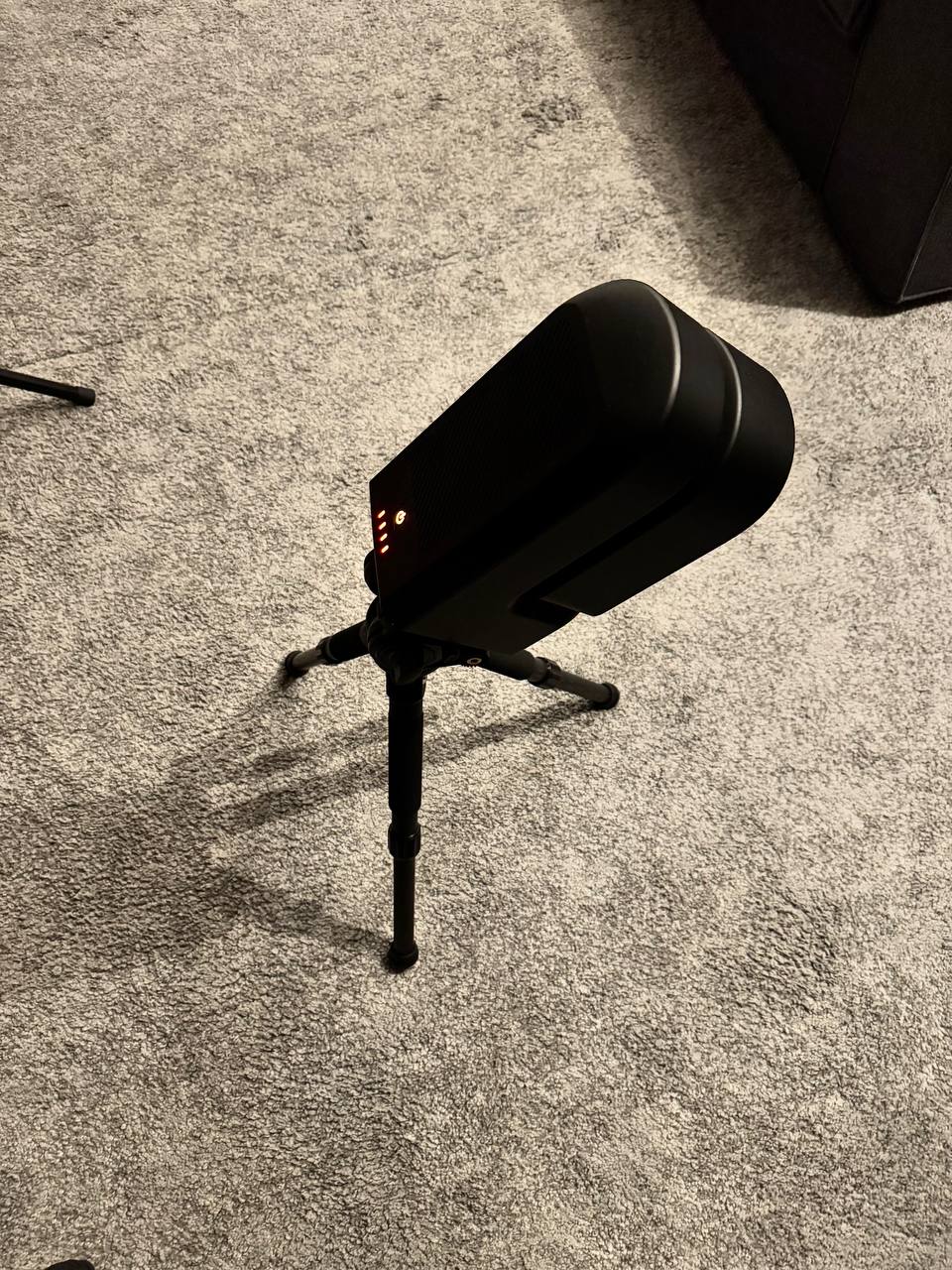
The Seestar S50 on its NEEWER fluid-head equatorial mount. The LEDs on the body confirm it’s powered up and tracking.
The mount is a NEEWER video fluid head used as a simple equatorial wedge — tilted to match London’s latitude so the Seestar’s built-in tracker compensates for Earth’s rotation along the right axis. Not a proper equatorial mount, but it unlocks 30-second sub-exposures per frame, which makes a meaningful difference when stacking.
Planning with AI
Before stepping outside, I asked my AI assistant to build an observation plan for the evening — factoring in which objects would be well-positioned, their altitude windows, and how much time I could realistically spend on each target given the night’s forecast.
The result was a four-target session, which I then loaded manually into the Seestar app:
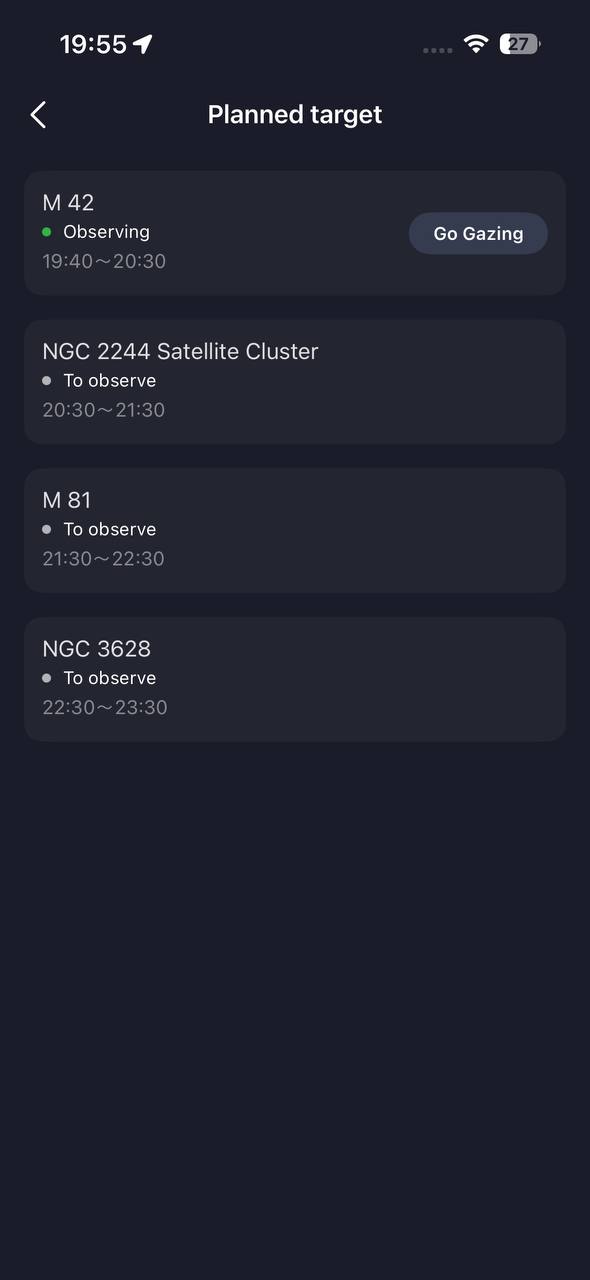
The AI-generated observation plan. Four targets, each with a one-hour window.
- 19:40 – 20:30 — M42 (Orion Nebula)
- 20:30 – 21:30 — NGC 2244 (Rosette Nebula satellite cluster)
- 21:30 – 22:30 — M81 (Bode’s Galaxy)
- 22:30 – 23:30 — NGC 3628 (Leo Triplet)
The Results
M42 — The Orion Nebula
The classic. 22 minutes of integration, and the Seestar pulled out more than I expected: the Trapezium cluster at the heart of the nebula, the surrounding gas clouds in warm orange and blue, dust lanes threading through the frame. Even from central London.
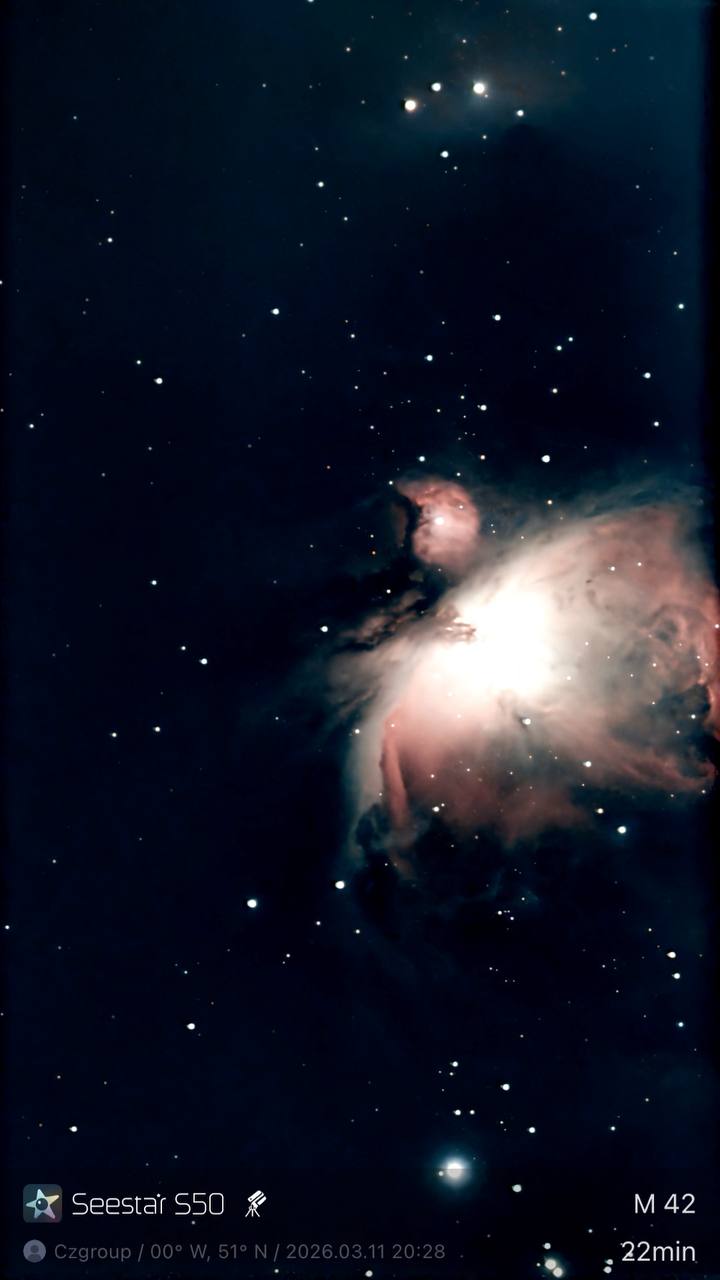
M42 — the Orion Nebula. 1,344 light-years away. 22 minutes integration, 20:28. The Trapezium is visible at the core; gas pillars and dark dust lanes extend outward.
NGC 2244 — The Rosette Cluster
This was the surprise of the night. NGC 2244 is the open cluster at the centre of the Rosette Nebula — a ring of ionised hydrogen that’s notoriously difficult to image with light pollution because it’s faint and diffuse. With 31 minutes of integration, the Seestar pulled out not just the cluster, but the surrounding nebula structure — warm rust-brown gas wrapping around the stars. In London. I wasn’t expecting that.
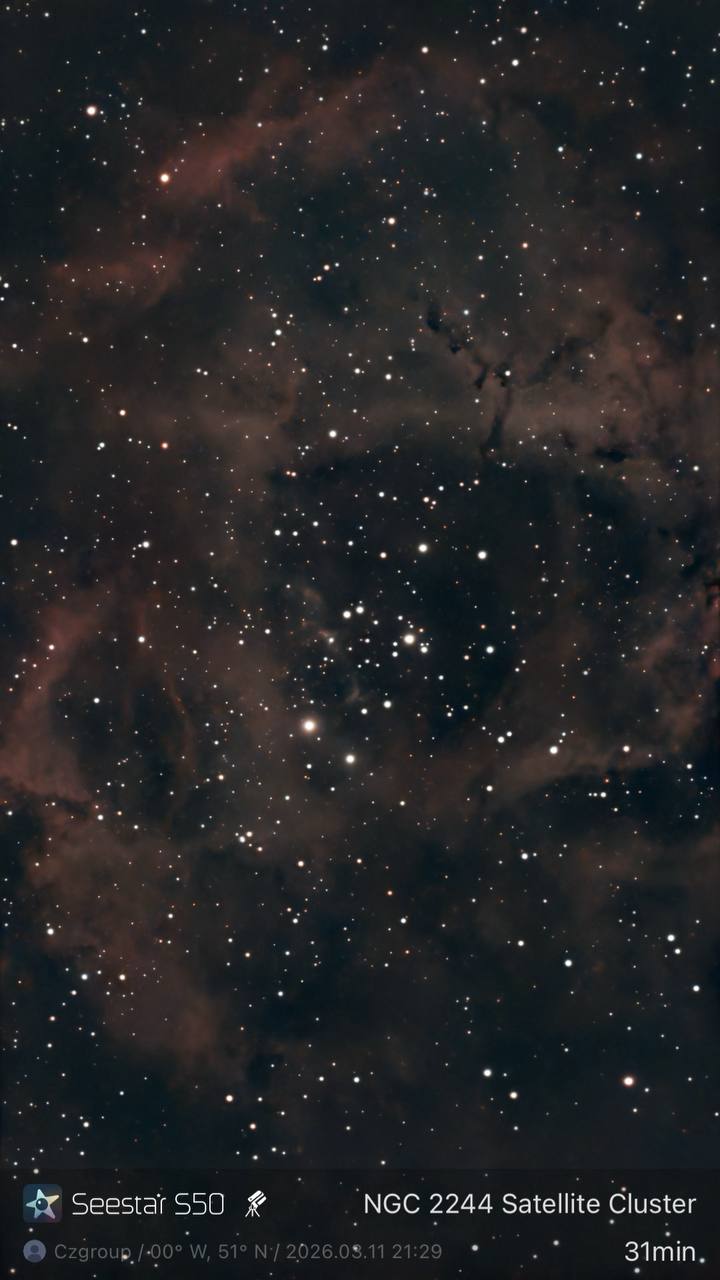
NGC 2244 — the Rosette Cluster, embedded in the Rosette Nebula. 5,200 light-years away. 31 minutes integration, 21:29. The surrounding nebulosity is visible from central London.
M81 + M82 — Bode’s Galaxy and the Cigar Galaxy
Two galaxies for the price of one. M81 (Bode’s Galaxy) is the classic spiral — perfectly face-on, with a bright nucleus and tight arms. M82 (the Cigar Galaxy) sits just south of it in the frame, edge-on, chaotic, visibly disturbed by gravitational interaction with its neighbour. 37 minutes of integration from 12 million light-years away.
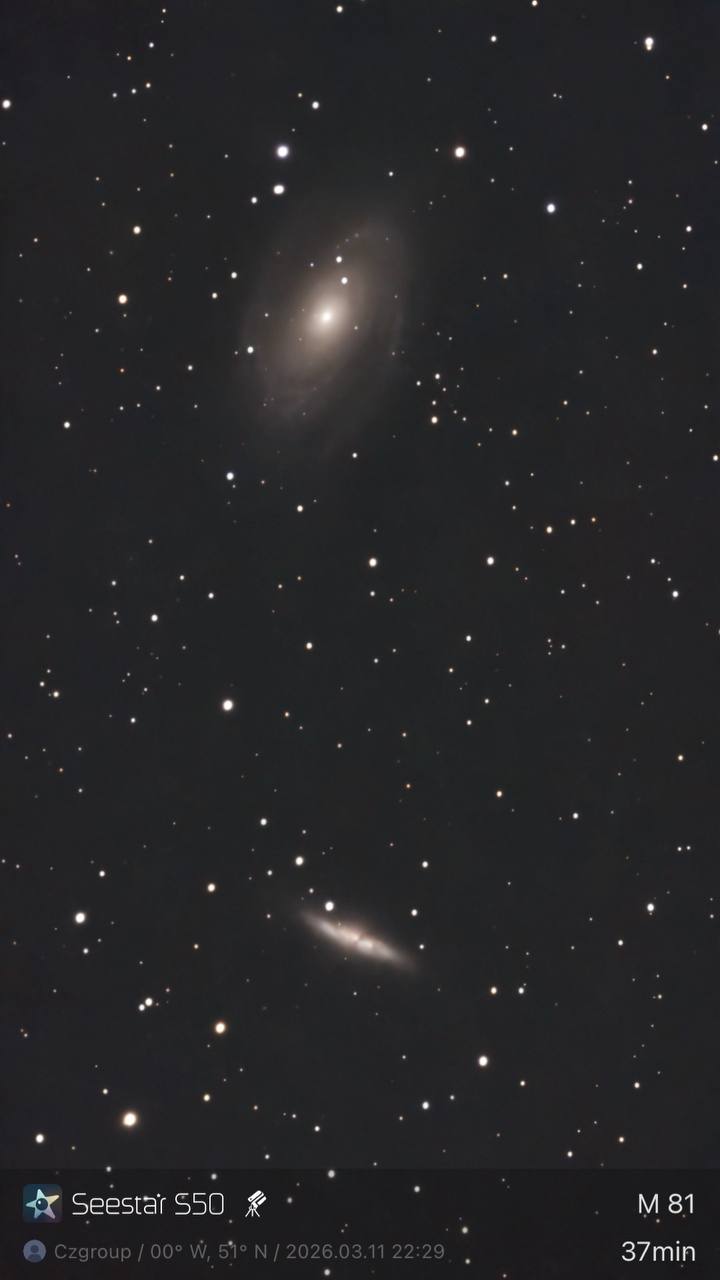
M81 (top) and M82 (bottom) — the Bode’s Galaxy pair in Ursa Major. 12 million light-years away. 37 minutes integration, 22:29. The gravitational interaction between them has distorted M82’s disc.
NGC 3628 — The Hamburger Galaxy
The final target of the night. NGC 3628 is part of the Leo Triplet — three galaxies clustered together in Leo. This one is edge-on, with a dramatic dark dust lane splitting it along the equator. You can also make out two companion galaxies in the field: M66 and M65 to the right. 27 minutes of integration, finished at 23:20.
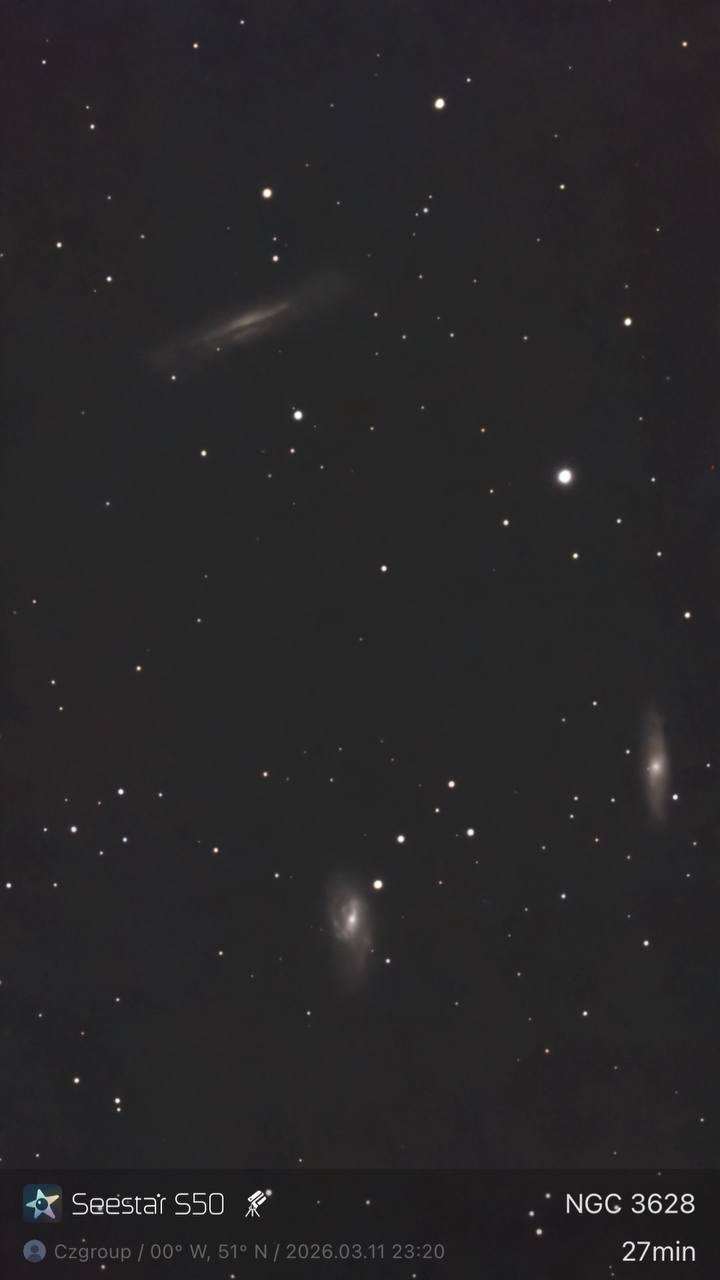
NGC 3628 (top left, edge-on) and two other Leo Triplet members. 35 million light-years away. 27 minutes integration, 23:20. The dark equatorial dust lane on NGC 3628 is clearly resolved.
What Made the Difference
A few things contributed to an unusually productive session:
The plan. Having a structured target list meant zero time wasted deciding what to point at next. Four objects in one evening, with real depth on each.
The mount. The equatorial wedge enables 30-second sub-exposures per frame. The difference shows — NGC 2244 at 31 minutes and M81 at 37 minutes both came out sharp.
The conditions. London rarely gives you a night like this. Clear from dusk to midnight, minimal turbulence, just enough darkness to pull out faint nebulosity.
The Seestar S50 is not a serious telescope. But with a proper plan, a stable mount, and a clear London night, it can capture things that would have been impossible with visual-only amateur equipment twenty years ago.